Last updated on November 17th, 2026 at 03:07 pm
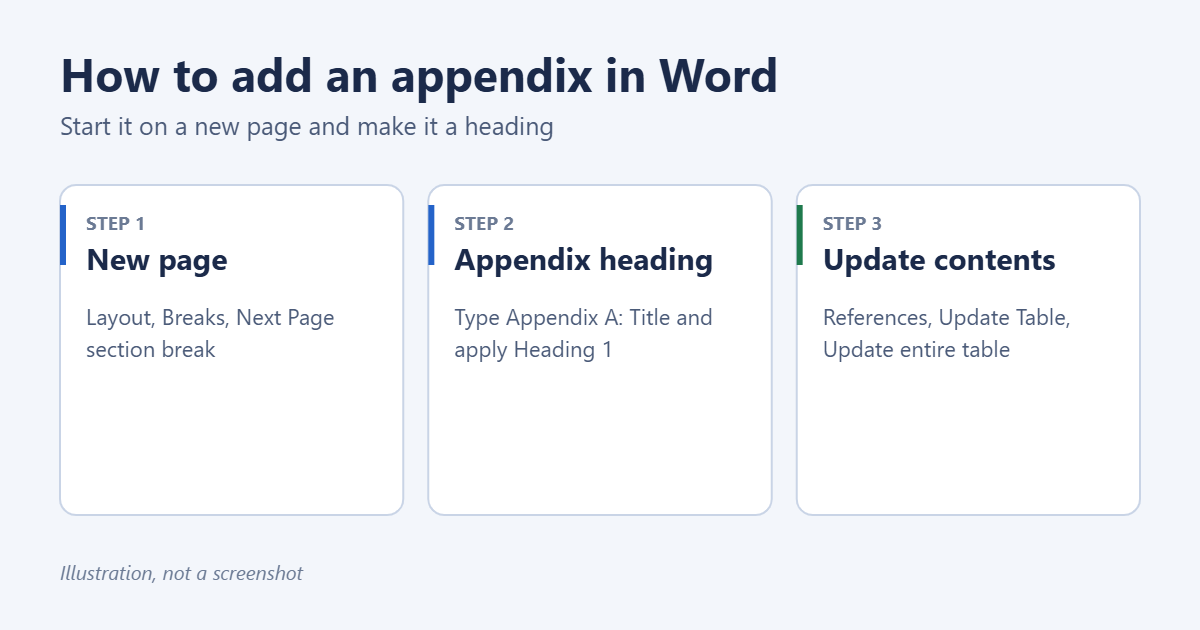
An appendix in Word starts with a section break at the end of your document: Layout > Breaks > Next Page. Type a title such as Appendix A: Survey Questions, apply Heading 1 from the Home tab, and add content below. Then use References > Update Table so the appendix shows in your table of contents.
Word for Microsoft 365, 2024, 2021 and 2019 on Windows and Mac follow these steps, and most also work in Word for the web.
What goes in an appendix?
An appendix holds material that supports your document but would interrupt the main text: survey questions, raw data tables, interview transcripts, detailed calculations, code listings, extra figures or copies of forms. Each appendix usually gets a letter (Appendix A, B, C) and a short descriptive title. If you follow a style guide such as APA or your university’s thesis rules, check its requirements for titles, page numbering and placement.
Step 1: Start the appendix on a new page
- Click at the very end of your last page, usually after the references or bibliography.
- Select Layout > Breaks > Next Page. This starts a new section on a new page.
A section break, rather than a simple page break, lets you give the appendices their own headers, page numbering or orientation later without affecting the rest of the document. If you don’t need any of that, Insert > Page Break (Ctrl + Enter) works too, as shown in inserting a page break in Word.
Step 2: Add the appendix heading
- On the new page, type the appendix title, for example Appendix A: Interview Questions.
- Select the title and choose Heading 1 in the Styles gallery on the Home tab.
- Press Enter and add the appendix content.
- For the next appendix, insert another page break and repeat with Appendix B.
Using a heading style is what makes the appendix show up in the table of contents and the Navigation pane. If your heading styles look different, making something a heading in Word explains how they work.
Format the heading without changing other headings
If your style guide wants appendix titles centered or in a different size from chapter headings, create a separate style:
- Select the appendix title.
- Open the Styles gallery and select Create a Style.
- Name it Appendix, select Modify, and set Style based on to Heading 1.
- Change the font and alignment as needed, then select OK.
Does this work in Word for the web?
You can add headings, page breaks and a table of contents in Word for the web. Custom styles, captions with new labels and section-specific page numbering need the desktop app.
Writing a paper? You may also need to set up APA format in Word or set up MLA format in Word.
Step 3: Add the appendix to the table of contents
- Click in your table of contents.
- Select References > Update Table.
- Choose Update entire table and select OK.
If you created a custom Appendix style, add it to the table: select References > Table of Contents > Custom Table of Contents > Options, type 1 next to Appendix under TOC level, and select OK twice. Entries that still look wrong usually need the fixes in fixing a table of contents in Word.
Add a separate list of appendices
Some theses list appendices on their own page instead of in the main contents. To do that:
- Use the custom Appendix style for all appendix titles, as described above.
- Click where you want the list and select References > Table of Contents > Custom Table of Contents.
- Select Options. Clear the numbers next to every style except Appendix, set Appendix to 1, and select OK twice.
- Type a heading such as List of Appendices above it.
- In the main table of contents, remove the Appendix style the same way so appendices aren’t listed twice.
Should appendices be labeled with letters or numbers?
Letters (A, B, C) are most common. If there’s only one appendix, many style guides call it just “Appendix”.
Number figures and tables in an appendix
Style guides often want appendix figures numbered separately, such as Figure A1 and Table B2.
- Select the figure or table and select References > Insert Caption.
- Select New Label and type a label such as Figure A. Select OK.
- Word numbers captions with that label 1, 2, 3, giving Figure A1, Figure A2 and so on. Create a Figure B label for Appendix B.
Number appendix pages differently
Because you used a section break, you can change page numbers in the appendices only.
- Double-click the footer on the first appendix page.
- Select Link to Previous on the Header & Footer tab to turn it off, so changes don’t affect earlier pages.
- Select Page Number > Format Page Numbers.
- Choose a number format and select Start at to restart numbering. For “A-1” style numbering, select Include chapter number and choose the heading style your appendix titles use.
- Select OK, then Close Header and Footer.
Add a PDF or spreadsheet as an appendix
- PDF: select Insert > Object > Create from File and choose the PDF. Word shows only the first page as an icon or image. For every page to print, open the PDF in Word with File > Open, which converts it, or insert each page as a picture.
- Excel data: copy the cells in Excel and paste them into Word as a table. For a large sheet, use Paste Special > Picture so the layout doesn’t change.
- Wide tables: put them in their own section and change the orientation with Layout > Orientation > Landscape.
Refer to an appendix in your text
To mention an appendix with a link that stays correct if you reorder things, select Insert > Cross-reference, set Reference type to Heading, choose the appendix, and select Insert. Press Ctrl + A and then F9 to update all cross-references before you submit.
Appendices missing from the contents
The appendix doesn’t show up in the table of contents
The title isn’t using a heading style, or the table hasn’t been updated. Apply Heading 1 to the title, then update the entire table.
Changing the appendix page numbers changed the whole document
Link to Previous was still on. Undo, turn off Link to Previous in the appendix footer, and try again.
The appendix title is numbered like a chapter
Your Heading 1 style uses chapter numbering. Use a separate Appendix style without numbering, or type “Appendix A” manually.
Landscape pages changed the orientation of other pages
Use Next Page section breaks before and after the landscape pages so only that section changes.

Matt Jacobs writes and maintains the guides on Support Your Tech, which he started in 2017. He spent most of his career keeping small-business PCs running and still takes the occasional consulting job, so the steps here come from fixing the same problems on other people’s computers. Each guide follows Microsoft, Apple and Google’s own documentation and is updated when the steps change. Screenshots marked “Recreated” are illustrations of the real screens.