Right-click an empty spot on the taskbar and select Taskbar settings. There you can show or hide Search, Task view and Widgets, pick which icons appear near the clock, and change Taskbar behaviors such as alignment. To add an app, right-click it and select Pin to taskbar.
Applies to: Windows 11.
Open taskbar settings
- Right-click an empty spot on the taskbar.
- Select Taskbar settings.
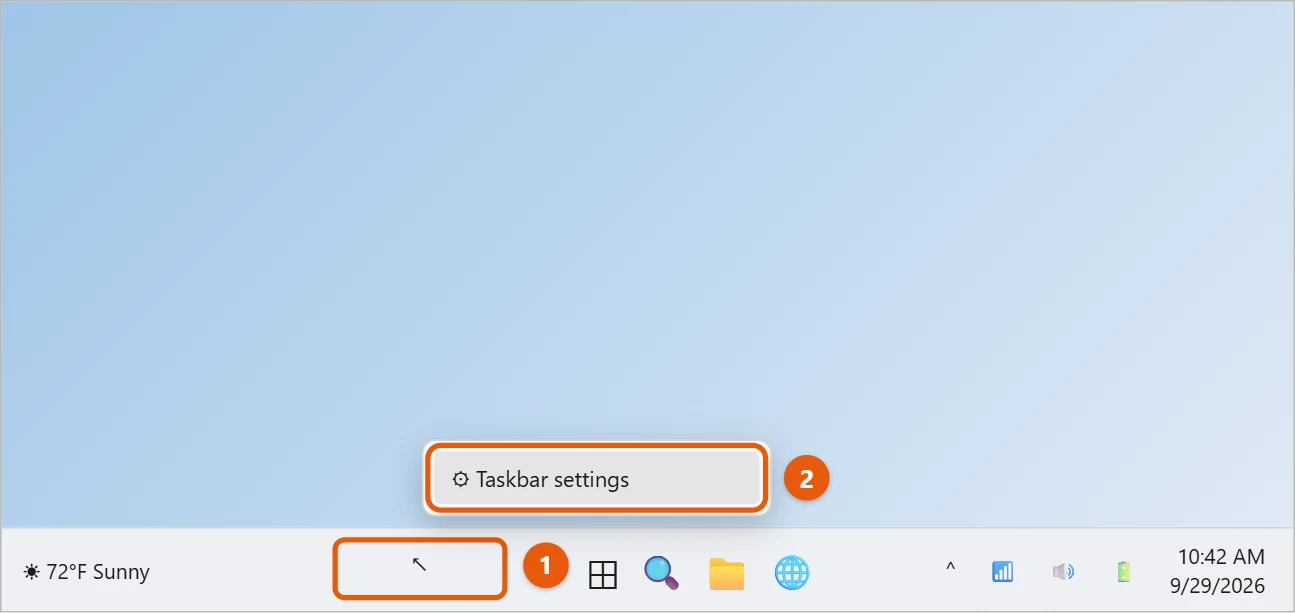
You can also go to Start > Settings > Personalization > Taskbar.
Choose what shows on the taskbar
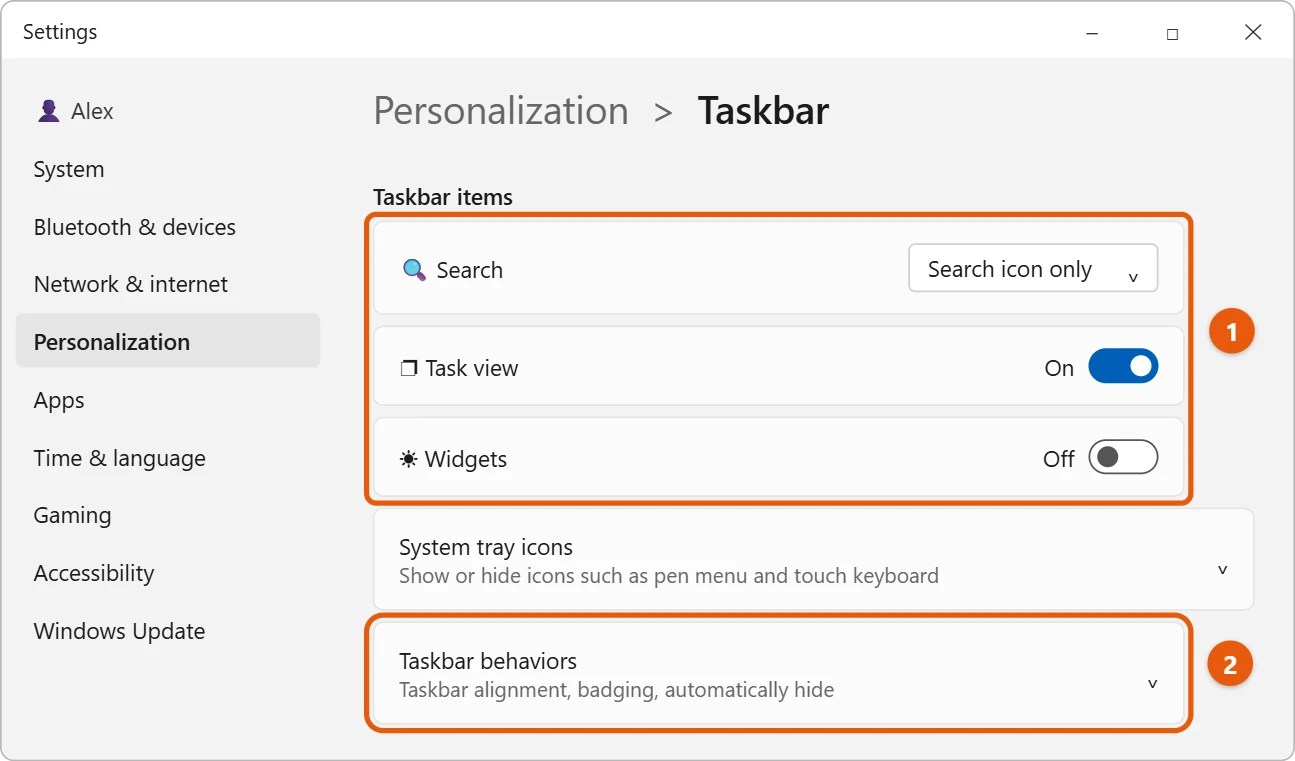
- Taskbar items: show Search as a box, an icon, or not at all, and turn Task view and Widgets on or off.
- System tray icons: choose icons such as the pen menu and touch keyboard.
- Other system tray icons: choose which app icons show next to the clock instead of under the arrow.
- Taskbar behaviors: set Taskbar alignment to Left or Center, and turn on Automatically hide the taskbar.
Pin and unpin apps
- Pin: select Start, find the app, right-click it and select Pin to taskbar.
- Unpin: right-click the app on the taskbar and select Unpin from taskbar.
- Reorder: drag icons left or right.
More Taskbar behaviors worth knowing
Expand Taskbar behaviors on the taskbar settings page to find these:
- Taskbar position: on PCs with the September 2026 update, move the taskbar to the top, left, or right of the screen.
- Show badges on taskbar apps: turns the little unread counters on or off.
- Show flashing on taskbar apps: stops apps from flashing orange when they want attention.
- Show smaller taskbar buttons: fits more apps by shrinking the icons, either always or only when the taskbar is full.
- Select the far corner of the taskbar to show the desktop: click the far right edge to minimize everything.
Set up the taskbar on more than one monitor
With a second screen connected, expand Taskbar behaviors and use these options:
- Show my taskbar on all displays: turn it off to keep the taskbar only on your main screen.
- When using multiple displays, show my taskbar apps on: choose All taskbars, Main taskbar and taskbar where window is open, or Taskbar where window is open. The last option keeps each screen’s taskbar limited to the windows on that screen.
The Start button, search, and system tray stay on the main display’s taskbar. Choosing which screen is the main one is part of setting up multiple monitors in Windows 11.
Customize the system tray and clock
- Hide or show app icons: under Other system tray icons, turn on any app you want next to the clock. Everything else stays under the up arrow, where you can also drag icons in and out.
- Edit Quick Settings: select the network, volume, or battery icon, then the pencil icon to add, remove, or rearrange buttons such as Bluetooth, Night light, and Airplane mode.
- Show seconds on the clock: under Taskbar behaviors, check Show seconds in system tray clock. It uses a little more power, so it’s best left off on laptops.
- Hide the clock and date: go to Settings > Time & language > Date & time and turn off Show time and date in the System tray.
Pin folders, websites, and the Recycle Bin
The taskbar pins apps by default, but a shortcut lets you pin almost anything:
- Right-click the desktop and select New > Shortcut.
- For a folder, type
explorer.exefollowed by a space and the folder path, such asexplorer.exe C:\Users\Public\Documents. For the Recycle Bin, typeexplorer.exe shell:RecycleBinFolder. - Name the shortcut and select Finish.
- Right-click the new shortcut, select Show more options, then Pin to taskbar. You can delete the desktop shortcut afterward.
To pin a website, open it in Microsoft Edge, select Settings and more (the three dots) > More tools > Pin to taskbar.
Use jump lists and taskbar shortcuts
- Jump lists: right-click a taskbar app to see its recent files or common tasks. Hover over a file and select the pin icon to keep it at the top of that list.
- Windows + 1 to 9: opens or switches to the pinned app in that position, counting from the left.
- Windows + T: moves through the taskbar icons with the keyboard. Press Enter to open one.
- Shift + click an icon to open a new window of that app, and Ctrl + Shift + click to open it as an administrator.
To close a frozen app without opening Task Manager, go to Settings > System > For developers and turn on End task. Right-click the app on the taskbar and select End task to close it.
If your taskbar changes don’t work
- Personalization settings are locked. Windows needs to be activated to change most taskbar options.
- A setting doesn’t take effect. Restart Windows Explorer: press Ctrl + Shift + Esc, right-click Windows Explorer, and select Restart.
- An option is missing. Newer options arrive with Windows updates. Check Settings > Windows Update for pending updates.
- Settings keep resetting. Third-party taskbar tools, such as Start menu replacements, can override Windows. Uninstall them to test.
Frequently asked questions
Can I move the taskbar to the top or side?
Yes, on PCs with the September 2026 update: set Taskbar position under Taskbar behaviors. There is more detail on moving the taskbar in Windows 11. If you would rather it disappear when you’re not using it, you can hide the taskbar in Windows 11.
Can I change its color?
Yes. The color is set in Personalization, as shown in changing the taskbar color in Windows 11.
Can I make the taskbar see-through?
Slightly. Go to Settings > Personalization > Colors and turn on Transparency effects. The taskbar becomes a little translucent. Fully clear taskbars need third-party apps.
Can I ungroup taskbar buttons so each window shows separately?
Yes. Under Taskbar behaviors, set Combine taskbar buttons and hide labels to Never. Each open window then gets its own button with its name.
How do I reset the taskbar to its default look?
Set alignment back to Center, turn the default items back on under Taskbar items, and unpin anything you added. There’s no single reset button.
Do these settings sync to my other PCs?
Pinned apps and most taskbar settings are saved per PC, so set them up on each computer.
Related: hiding or shrinking the search box, removing Teams from the taskbar, and customizing the rest of Windows 11.
Every taskbar setting is also listed on Microsoft’s taskbar customization page.

Matt Jacobs has been working as an IT consultant for small businesses since receiving his Master’s degree in 2003. While he still does some consulting work, his primary focus now is on creating technology support content for SupportYourTech.com.
His work can be found on many websites and focuses on topics such as Microsoft Office, Apple devices, Android devices, Photoshop, and more.