Word displays the word count in the status bar, the thin strip along the bottom of the window, next to the page number. It reads something like 523 words and updates as you type. If it isn’t there, right-click the status bar and select Word Count so it has a check mark. For the full breakdown (characters, paragraphs and lines), select Review > Word Count, or click the count in the status bar.
Applies to: Word for Microsoft 365, Word 2024, 2021, 2019 and 2016 on Windows and Mac, and Word for the web. Notes for the iPhone, iPad and Android apps are near the end. The desktop and web steps follow Microsoft’s Word count support page.
Turn on the word count in the status bar
The status bar is the gray or white bar under the page, below the scroll area. On the left it shows the page you’re on (for example Page 2 of 5), and the word count sits right beside it.
- Open your document in Word and look at the bottom-left corner of the window.
- If you see a page number but no word count, right-click an empty spot on the status bar. On a Mac, Control-click it.
- In the Customize Status Bar list, select Word Count. A check mark appears next to it, and the count shows up on the status bar right away.
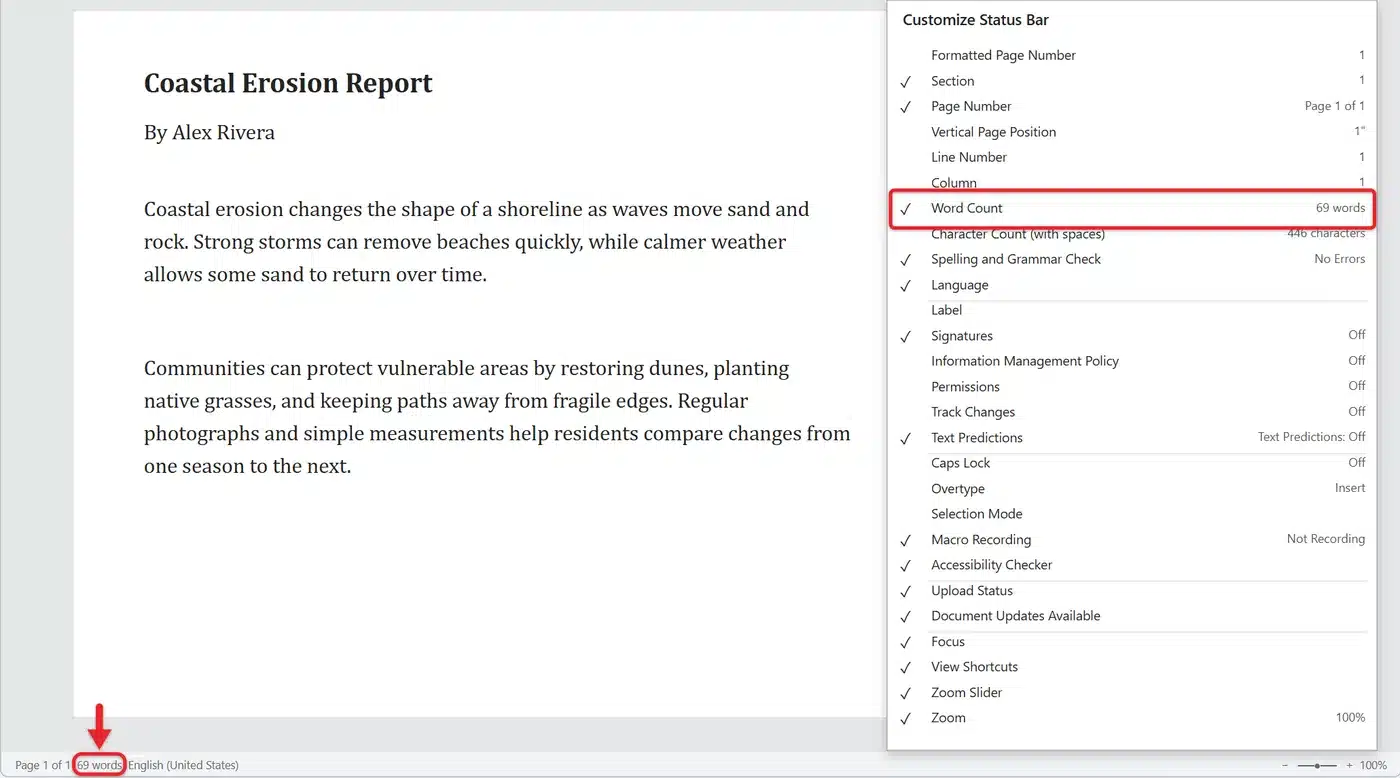
- Optional: in the same list, select Character Count (with spaces) if you also need a character total, for example for an application form with a character limit. Not every Word version has this item.
- Click anywhere in the document to close the list.
The setting sticks, so the count will be there the next time you open Word. To hide it again, repeat the steps and clear the check mark.
Count the words in part of a document
Select the text you want to measure, such as one section of a report or the answer to one question. The status bar changes from the total to something like 120 of 523 words: the first number is your selection, the second is the whole document.
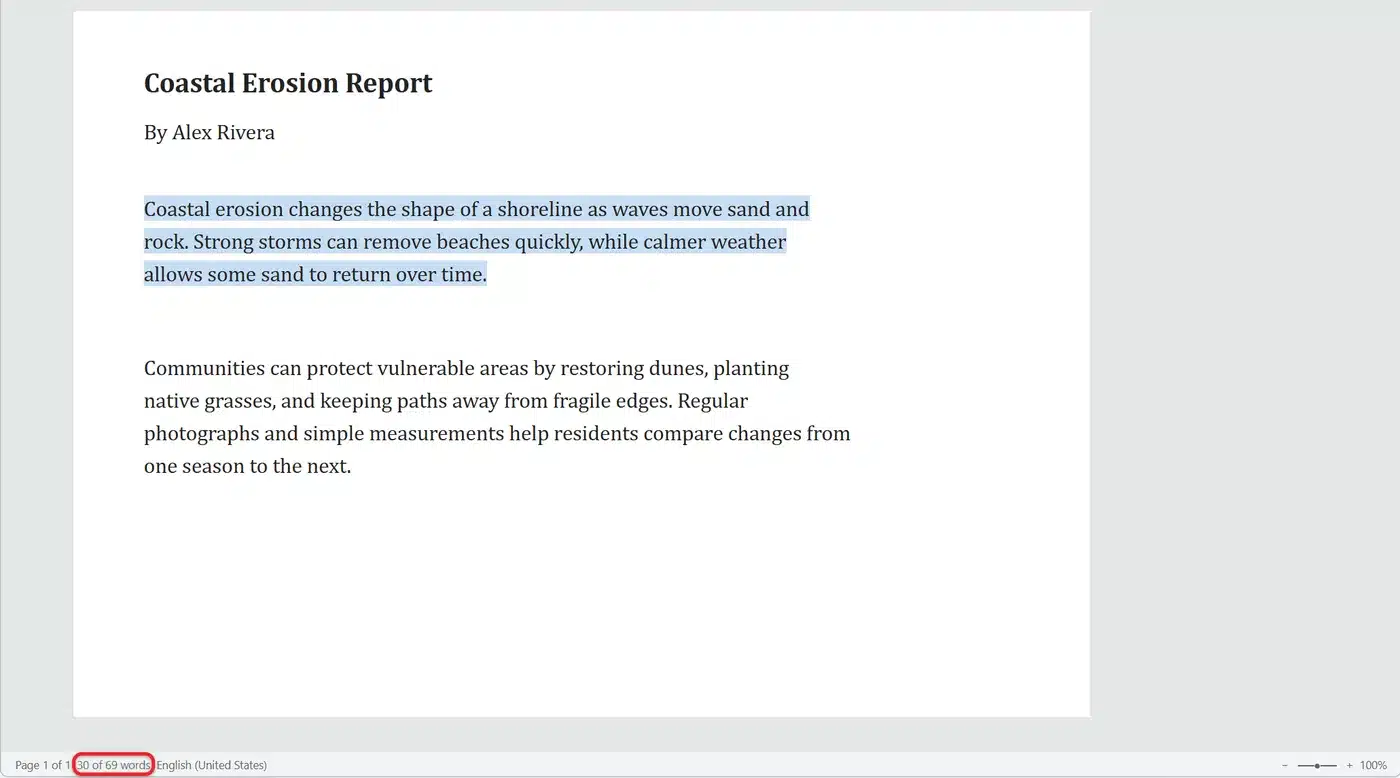
To add up passages that aren’t next to each other, select the first one, then hold Ctrl (Command on a Mac) while you select the others. The status bar adds them together.
This is the easiest way to check an essay against a limit that leaves out the title page, headings or reference list. For example, if Priya’s assignment allows 1,500 words “excluding references,” she can drag from the first line of the introduction to the end of the conclusion and read the first number. When you’re done, click once anywhere in the text and the status bar goes back to the total.
Open the full Word Count box
- Click in the document. If you want statistics for only part of it, select that part first.
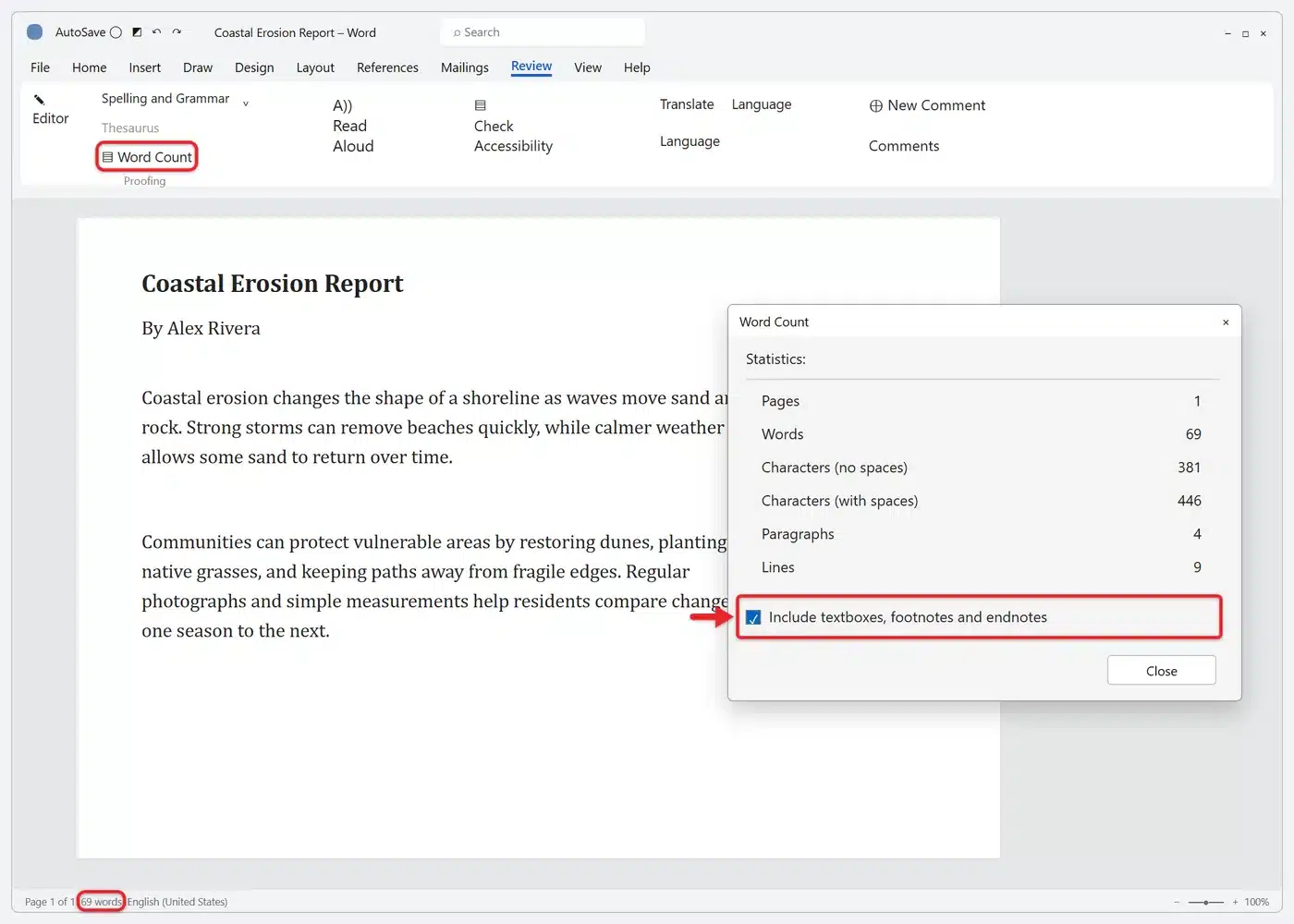
- Select Review > Word Count (in the Proofing group), or click the word count on the status bar. On Windows you can also press Ctrl + Shift + G.
- Read the counts for Pages, Words, Characters (no spaces), Characters (with spaces), Paragraphs and Lines.
- Check Include textboxes, footnotes and endnotes if those should be part of your total, or clear it to leave them out. The numbers update as soon as you change the box.
- Select Close.
Two things to know: the Lines figure counts lines on the page, not sentences, so it changes with your font size and margins. And if you write with lots of notes, the footnote setting can make a big difference. Our guide to inserting footnotes in Word explains how notes are added and where they appear. Page counts shift the same way with formatting such as double spacing in Word, while the word count stays put.
You can also see a saved word total without opening the dialog: select File > Info and look under Properties on the right. For more detail, select Properties > Advanced Properties and open the Statistics tab. These figures always cover the whole document, never a selection.
Print the word count inside the document
Some teachers and editors want the word count written on the cover page or under the title. You can type it in by hand, or insert a field that Word fills in for you.
- Click where the number should go, for example after the text Word count: on your title page.
- Select Insert > Quick Parts > Field. On a Mac, use Insert > Field from the menu bar.
- In the Field names list, select NumWords, leave the format as it is, and select OK.
The field takes its number from the document’s statistics, the same total you see under File > Info > Properties, so it does not change as you type. Before you submit or print, click the number and press F9, or right-click it and choose Update Field. To refresh every field at once, press Ctrl + A and then F9. If the number still looks behind, save the document and update it again.
If you see something like { NUMWORDS } instead of a number, press Alt + F9 to switch back from field codes to results. For a character total, use the NumChars field instead. Keep in mind the field counts the whole document, including the title page it sits on, so if your limit excludes some parts, type the number from a selection count instead. If your paper follows MLA style, see how to include a word count in MLA format for where it should go.
Word on a Mac
Word for Mac works the same way as Windows. The count is on the status bar at the bottom of the window; Control-click the status bar to turn Word Count on if it’s missing. Click the count, or select Review > Word Count, to see the full statistics box with the same footnote and text box option. The Tools menu in the menu bar at the top of the screen also has a Word Count command.
For a partial count on a Mac, select the text before you open the box. With nothing selected, the box covers the whole document.
Word for the web
In Word for the web (Word in a browser through Microsoft 365 or OneDrive), the word count appears at the bottom of the window only while you’re editing.
- Open the document and make sure you’re in editing mode. If the document opened for viewing only, select Edit Document (or the Editing button) and choose to edit in the browser.
- Look at the bottom-left of the window for the word count. Click it to switch the count on or off.
- For characters and paragraphs, select Review > Word Count.
Microsoft notes that the web count is approximate because it skips text boxes, headers, footers and SmartArt. If you need an exact figure for a submission, open the file in the Word desktop app and check its status bar there.
Word on iPhone, iPad and Android
The mobile apps don’t keep a running count on screen, but you can check the total from the Review tab.
- iPad: tap Review at the top of the screen, then tap the Word Count button.
- iPhone and Android phones: tap the edit (pencil) icon or the arrow at the bottom to open the ribbon, tap the tab name on the left to switch to Review, then tap Word Count.
The layout of these menus changes between app updates, so if you can’t find the button, look for the tab menu first and switch it to Review.
What Word counts as a word
- Word counts any run of characters with a space on each side, so numbers (“2026”), single letters (“a”) and web addresses each count as one word.
- Hyphenated words such as “well-known” count as one. Two words joined by a long dash with no spaces around it also count as one; put spaces around the dash and they count as two.
- Comments and tracked-change balloons in the margin aren’t counted. Headers and footers aren’t part of the main count either.
- Text boxes, footnotes and endnotes are counted only when Include textboxes, footnotes and endnotes is checked in the Word Count box.
Because other apps make different choices about dashes, slashes and symbols, Google Docs or an online checker can give a slightly different number for the same text.
See sentences and reading level too
If you also want sentence counts, average words per sentence and reading-level scores, Word can produce them.
- Word for Microsoft 365 (Current Channel): select Home > Editor > Document stats, then OK when Word says it’s calculating.
- Older Windows versions: select File > Options > Proofing. Under When correcting spelling and grammar in Word, check Check grammar with spelling and Show readability statistics, then select OK. Run Review > Spelling & Grammar and work through it to the end.
- Mac: select Word > Preferences > Spelling & Grammar, check Check grammar with spelling and Show readability statistics, then run Review > Spelling & Grammar.
The results include the Flesch Reading Ease score (higher is easier; Microsoft suggests 60 to 70 for most documents) and the Flesch-Kincaid Grade Level. The steps are on Microsoft’s readability statistics page.
If the word count won’t show or looks wrong
The status bar itself is missing
The bottom of the Word window may be off the screen. Double-click the title bar at the top of the window, or select the maximize button, so the whole window fits. If Word is in Focus mode (a full-screen, distraction-free view), press Esc or select View > Focus to leave it. Switching to View > Print Layout also brings back the normal layout.
The status bar shows “X of Y words”
Some text is selected. Click once inside the document, without dragging, to see the total again.
The count is higher than you expected
Open Review > Word Count and check whether Include textboxes, footnotes and endnotes is on. Also check for hidden text, a long reference list or an appendix that your limit doesn’t include, and select only the text that counts.
The count is stuck or the option is missing
- Save and close the document, close every Word window, then reopen it.
- Check for updates: select File > Account > Update Options > Update Now on Windows.
- Test without add-ins: press Windows + R, type
winword /safeand press Enter. If the count works in Safe Mode, an add-in is the likely cause; turn add-ins off one at a time under File > Options > Add-ins. - Repair Office: in Windows 11, right-click Start, select Installed apps, find Microsoft 365 or Office, select the … button > Modify, and choose Quick Repair. Microsoft’s Repair an Office application page has the full steps, including Online Repair if Quick Repair doesn’t help.
Frequently asked questions
Can Word count the words in several documents at once?
No, the status bar and the Word Count box only measure the open document. For a combined total, copy the files into one new document, or insert one Word document into another with Insert > Object > Text from File, then check the count there.
Can I set a word goal or limit in Word?
Word has no built-in target or warning when you go over a limit. Keep the live count on the status bar while you write. If you’re over, our tips for cutting your word count help you trim without losing meaning.
How do I count characters instead of words?
Open Review > Word Count and read Characters (with spaces) or Characters (no spaces). Check which one your form or publisher means; most online forms count spaces.
Does the word count include the title and headings?
Yes. Titles, headings, captions in the main text and the reference list are all part of the total. If your instructions exclude any of them, select just the body text and use the first number on the status bar.
Once the count is showing, leave it on: a quick glance at the bottom of the window while you write is the simplest way to stay inside a limit.

Matt Jacobs writes and maintains the guides on Support Your Tech, which he started in 2017. He spent most of his career keeping small-business PCs running and still takes the occasional consulting job, so the steps here come from fixing the same problems on other people’s computers. Every guide is checked on his own Windows 11, Windows 10, Mac, iPhone and iPad before it goes up.