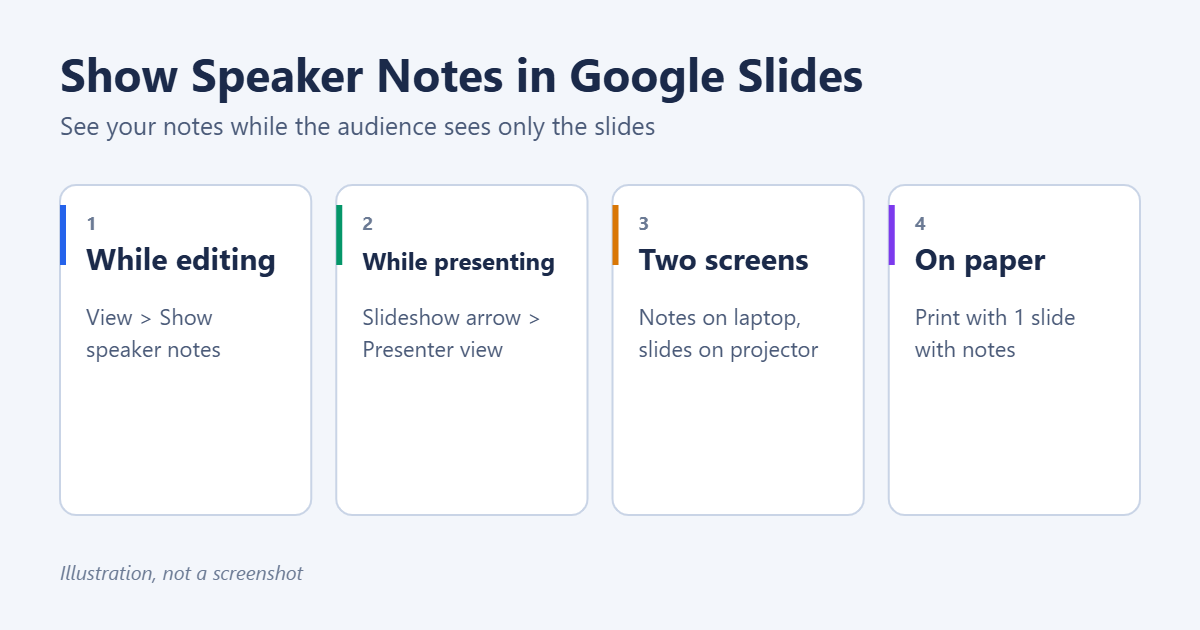
To show speaker notes in Google Slides while you’re editing, go to View > Show speaker notes. The notes box appears under the current slide. To see your notes while you present, click the small arrow next to the Slideshow button and choose Presenter view. Your audience sees only the slides, and you get a separate window with your notes, a timer and the next slide. Here’s how to set it up, including with two screens, on a video call, on a phone and on paper.
Show the speaker notes box while editing
- Open your presentation in Google Slides.
- Go to View > Show speaker notes. A checkmark appears next to it when it’s on.
- Click in the box under the slide that says Click to add speaker notes and type.
Drag the bar between the slide and the notes box up or down to give the notes more room. You can format notes with bold, italics, bullet points and links using the normal toolbar. If the notes box seems to have vanished, it has usually been dragged down to the bottom edge. Drag it back up, or turn the option off and on again.
See your notes while presenting (Presenter view)
- Click the down arrow next to Slideshow in the top right.
- Choose Presenter view.
- Two windows open: the full-screen slideshow, and a smaller Presenter view window with your notes.
The Presenter view window shows:
- Your speaker notes for the current slide, with + and – buttons to change the text size.
- Thumbnails of the previous and next slides.
- A timer you can pause and reset.
- An Audience tools tab for taking live questions.
Use the arrows in either window, or the arrow keys on your keyboard, to move between slides.
Already presenting? Open the notes from the toolbar
Move the mouse to the bottom left of the slideshow to show the toolbar. Click the three-dot menu and choose Open speaker notes, or Presenter view, depending on your version.
The Presenter view window didn’t appear
Your browser probably blocked it as a pop-up. Look for the blocked pop-up icon at the right end of the address bar, choose to always allow pop-ups from docs.google.com, and try again.
Handy keys while presenting
| Key | What it does |
|---|---|
| S | Opens the speaker notes |
| A | Opens audience tools |
| L | Turns the laser pointer on or off |
| B or W | Shows a black or white screen, which is useful for pausing |
| Right or left arrow | Next or previous slide |
| Esc | Ends the slideshow |
Click the slideshow window first so it receives the key presses. Press Ctrl + / while editing to see the full list of Google Slides shortcuts.
Present with two screens
When your laptop is connected to a projector or second monitor:
- On Windows, press Windows + P and choose Extend. On a Mac, turn off mirroring in System Settings > Displays.
- Start Presenter view.
- Drag the full-screen slideshow window onto the projector, and keep the Presenter view window on your laptop.
- If the slideshow isn’t full screen on the projector, click it and press Ctrl + Shift + F (or Cmd + Shift + F on a Mac).
If you choose Duplicate or mirroring instead, the audience will see your notes too.
Present on a video call
In Google Meet, Zoom or Teams, share only the slideshow window or browser tab, not your whole screen. Then open Presenter view in a separate window that you keep to the side. Your audience sees the slides while you read your notes. In Google Meet, you can also click Present from the slideshow and choose to present the tab directly.
Speaker notes on a phone or tablet
- Edit notes: In the Google Slides app, open the presentation and tap a slide, then tap Speaker notes under it to view or type notes.
- Present with notes: When you present from the app to another screen, such as a TV or a video call, your phone shows the speaker notes while the other screen shows the slides. The exact options depend on the device and app version.
Print or download your notes
- Go to File > Print preview (it may be called Print settings and preview).
- Choose 1 slide with notes from the layout options.
- Click Print, or Download as PDF to keep a digital copy.
This is a good backup if the projector or Wi-Fi fails.
Tips for better speaker notes
- Write short bullet points, not a script. You’ll glance at notes rather than read them.
- Bold the one thing you must say on each slide.
- Add timing cues, such as “2 min”, to stay on schedule.
- Put links or figures you might be asked about at the bottom of the notes.
- Do a practice run in Presenter view, so you know where everything is.
Speaker notes and PowerPoint files
If you open or import a PowerPoint file in Google Slides, its speaker notes come across with it. If you download your presentation as a .pptx file, the notes go with it too, so you can present from PowerPoint if you need to. For PowerPoint tips, see how to loop a PowerPoint presentation and how to duplicate a slide in PowerPoint.
Frequently asked questions
Can the audience see my speaker notes?
Not in the slideshow. They can see them if they open the presentation file itself and you’ve shared it with them, or if you share your whole screen while Presenter view is visible.
How do I hide the notes box while editing?
Go to View > Show speaker notes again to turn it off.
Can I make the notes text bigger?
Yes. Use the + button in Presenter view, or zoom the browser with Ctrl and + while the Presenter view window is selected.
Summary
- While editing: View > Show speaker notes.
- While presenting: Slideshow arrow > Presenter view.
- With a projector: extend your display and keep Presenter view on your laptop.
- On paper: Print preview > 1 slide with notes.

Matt Jacobs has been working as an IT consultant for small businesses since receiving his Master’s degree in 2003. While he still does some consulting work, his primary focus now is on creating technology support content for SupportYourTech.com.
His work can be found on many websites and focuses on topics such as Microsoft Office, Apple devices, Android devices, Photoshop, and more.