Last updated on November 9th, 2026 at 02:07 pm
You’ve got a photo saved on your PC and you want it on the desktop right now. The fastest way: find the picture in File Explorer, right-click it and select Set as desktop background. For control over how it fits, go to Settings > Personalization > Background instead.
Applies to: Windows 10 desktops and laptops (version 22H2).
Set a picture as your wallpaper in two clicks
From File Explorer
- Open File Explorer (Windows key + E) and go to the folder with your picture, such as Pictures or Downloads.
- Right-click the picture and select Set as desktop background.
The desktop changes immediately. This route uses whatever fit you chose last time, so if the picture is cropped oddly, adjust it in Settings as shown below. You can select several pictures, right-click and choose the same command to start a quick slideshow of just those images.
From Settings, with Browse
- Right-click an empty spot on the desktop and select Personalize, or open Settings > Personalization > Background.
- In the Background drop-down, select Picture.
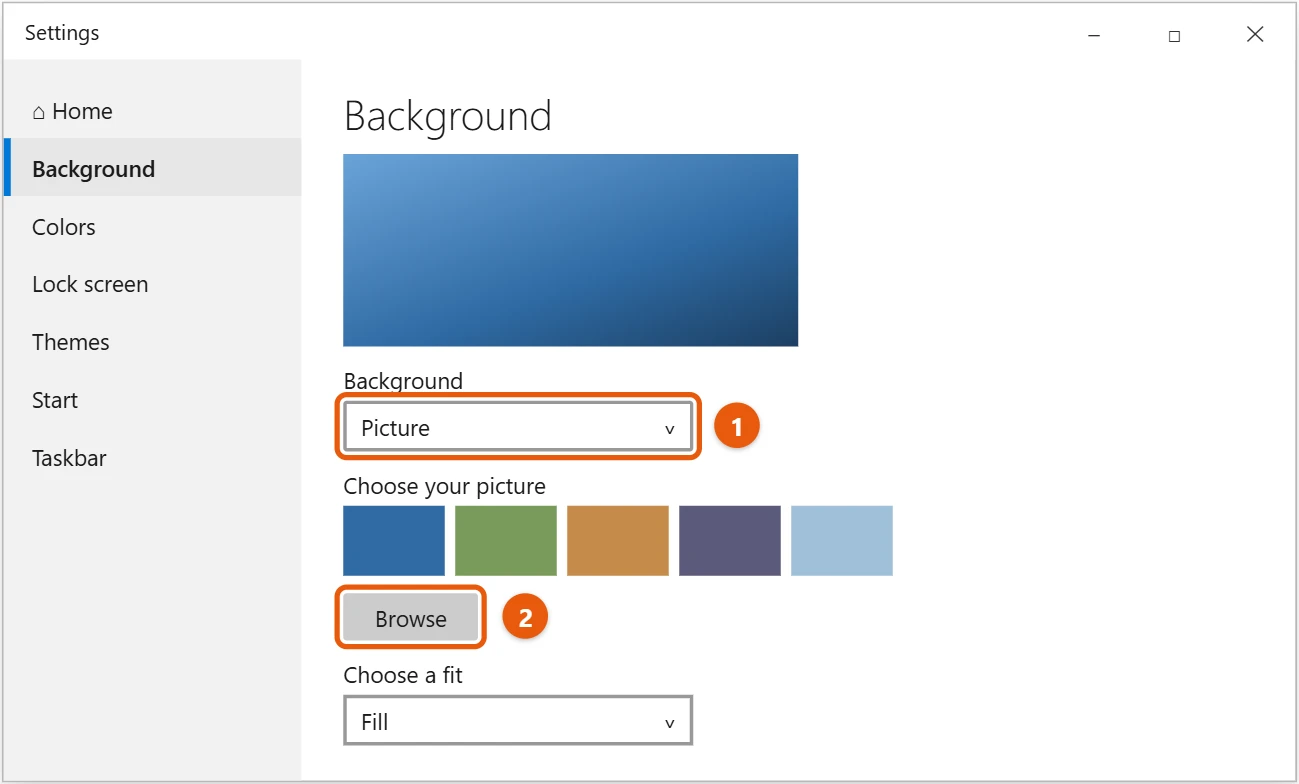
- Select one of the recent pictures, or select Browse, find your image and select Choose picture.
- Under Choose a fit, pick how the image should fill the screen (the next section explains each option).
The preview at the top of the page updates as you go, and the desktop changes as soon as you pick a picture. There’s no Save button.
From the Photos app
Open the picture in Photos, select the … (See more) menu, then Set as > Set as background. Menu labels in Photos have changed between app versions, so if you don’t see it, use File Explorer instead.
Only the desktop changes with any of these methods. The picture behind the sign-in and lock screens is a separate setting: see how to change the lock screen in Windows 10 or change the Windows 10 login screen.
Choose how the picture fills the screen
Pictures rarely match the screen’s shape exactly. The fit option decides what happens to the difference.
| Fit | What it does | Good for |
|---|---|---|
| Fill | Scales the picture to cover the whole screen, cropping edges if needed | Most photos |
| Fit | Shows the whole picture, adding bars of the background color where it doesn’t reach | Pictures you don’t want cropped, like a group photo |
| Stretch | Stretches the picture to the screen’s exact shape, which can distort it | Images with no faces or text |
| Tile | Repeats a small image across the screen | Patterns and textures |
| Center | Shows the picture at its original size in the middle | Logos or small artwork |
| Span | Spreads one picture across all monitors | Wide panoramic images on two or more screens |
With Fit or Center, the bars or border use the color you choose under Choose your background color, a little further down the page.
For a sharp result, use a picture at least as large as your screen resolution. To check yours, go to Settings > System > Display and look under Display resolution (for example, 1920 × 1080). A small picture set to Fill or Stretch is enlarged and looks soft. JPEG and PNG files both work.
Rotate pictures with a slideshow, or use a solid color
Slideshow
A slideshow cycles through every picture in one folder.
- Put the pictures you want in a single folder, such as Pictures\Wallpapers. Keep it on the PC rather than in an online-only cloud folder.
- In Settings > Personalization > Background, set Background to Slideshow.
- Under Choose albums for your slideshow, select Browse, pick the folder and select Choose this folder.
- Set Change picture every to an interval, from one minute to one day.
- Turn on Shuffle if you don’t want the pictures in file-name order.
- On a laptop, decide whether the slideshow should keep running on battery power. Turning that off saves a little power.
- Pick a fit, just as for a single picture.
To skip to the next picture early, right-click the desktop and select Next desktop background.
Solid color
Set Background to Solid color and pick a swatch, or select Custom color to choose any shade. A plain color makes desktop icons easy to read and is a tidy choice for screen sharing.
Themes and Windows spotlight
Settings > Personalization > Themes applies a set of wallpapers together with colors and sounds. A theme changes your background too, which is why a wallpaper sometimes changes “by itself” after someone applies one. Windows spotlight (Microsoft’s rotating photos) is mainly a lock screen option on Windows 10, under Settings > Personalization > Lock screen. If your Background drop-down also lists Windows spotlight, choosing it changes the desktop picture daily.
Use a different wallpaper on each monitor
With two or more screens, each can have its own picture.
- Open Settings > Personalization > Background and make sure Background is set to Picture.
- Add the pictures you want with Browse, so they appear under Choose your picture.
- Right-click a picture under Choose your picture.
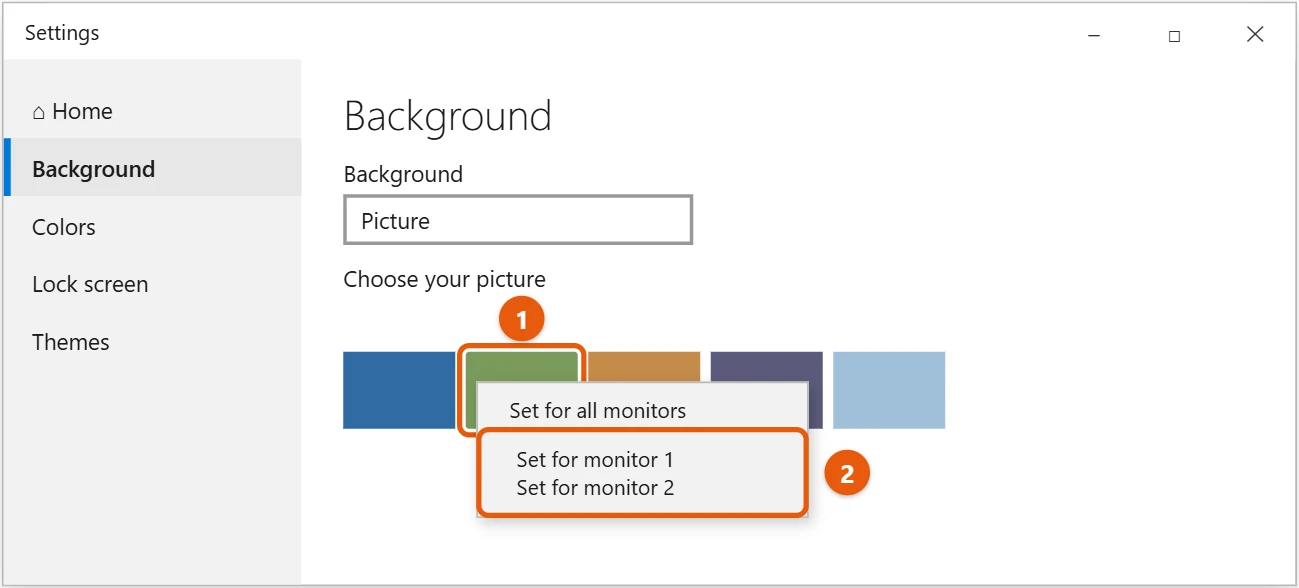
- Select Set for monitor 1 or Set for monitor 2, then repeat with another picture for the other screen.
Not sure which screen is monitor 1? In Settings > System > Display, select Identify and a number appears on each screen. If the second monitor isn’t listed at all, set up dual monitors in Windows 10 first. For layouts, panoramas and other tips, see using different wallpapers on dual monitors in Windows 10.
Find the picture behind your current wallpaper
Want to reuse a wallpaper but can’t remember where the file came from?
- Built-in Windows pictures live in
C:\Windows\Web\Wallpaper. Copy one somewhere else before editing it; don’t change the originals. - The current wallpaper: Windows keeps a working copy in
%AppData%\Microsoft\Windows\Themes, in a file named TranscodedWallpaper with no extension. Microsoft doesn’t document this file, so treat it as a convenience. Copy it to your Pictures folder and add.jpgto the name to open it. The copy may be resized from the original.
When the wallpaper won’t change or turns black
Work through whichever matches what you see.
- Settings asks you to activate Windows: Personalization settings are locked on an unactivated copy of Windows 10. The File Explorer right-click method usually still works.
- The options are grayed out with “Some of these settings are managed by your organization”: on a work or school PC, an administrator controls the background. Ask your IT team.
- The desktop is black: open Settings > Ease of Access > Display and, under Simplify and personalize Windows, make sure Show desktop background image is turned on.
- The wallpaper reverts after a restart: the picture may have been moved, deleted, or stored in an online-only OneDrive folder. Copy it into your Pictures folder and set it again.
- The slideshow is stuck: check that the folder still exists, holds supported image files, and is on the PC. Then set the slideshow again.
- The picture looks blurry or stretched: use a larger image and choose Fill instead of Stretch.
If you keep wallpapers from the web, download plain image files rather than “wallpaper installer” programs, which can bundle unwanted software.
Wallpaper questions people ask
Can I use a video or animated GIF?
Not with the built-in settings. Animated backgrounds need a separate app; the options are in setting a live wallpaper on Windows 10.
Why does my wallpaper keep changing on its own?
A slideshow or a theme is usually the cause. Set Background to Picture, and check Themes for a theme with several wallpapers.
Do virtual desktops get their own wallpaper?
Not in Windows 10’s Background settings, which apply one wallpaper to every virtual desktop. Choosing a background for each desktop is a Windows 11 feature, covered in setting any picture as your Windows 11 desktop background.
What picture size works for Span across two screens?
Add the widths and use the taller height. Two 1920 × 1080 monitors side by side make a 3840 × 1080 canvas, so a picture around that size (a wide panorama) spans without stretching. Example: Jordan has a 1920 × 1080 laptop screen beside a 2560 × 1440 monitor. Span uses one image across both, but the different sizes mean parts get cropped, so a separate picture per monitor usually looks better in that setup.
Will my wallpaper follow me to another PC?
Windows 10 has a sync option under Settings > Accounts > Sync your settings, with a Theme switch, for PCs signed in with the same Microsoft account. Results vary, especially when the picture file only exists on one PC, so the dependable way is to copy the picture to the other PC and set it there.
Does Microsoft have its own instructions?
Yes: change the desktop background in Windows lists the same background types and fit options, for both Windows 10 and Windows 11.
Once the picture looks right, you might move on to icons and colors. Lock screen, sign-in screen and desktop each have their own setting, so change each one you want to match.

Matt Jacobs writes and maintains the guides on Support Your Tech, which he started in 2017. He spent most of his career keeping small-business PCs running and still takes the occasional consulting job, so the steps here come from fixing the same problems on other people’s computers. Every guide is checked on his own Windows 11, Windows 10, Mac, iPhone and iPad before it goes up.