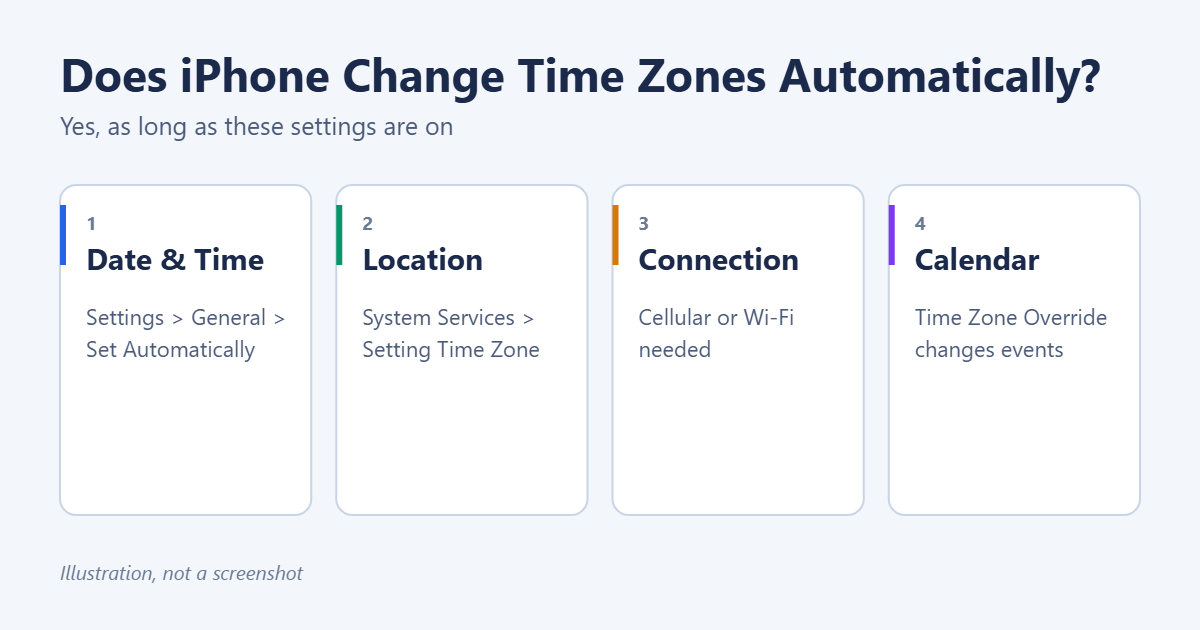
Yes. An iPhone changes time zones automatically when you travel, as long as Set Automatically is turned on in Settings > General > Date & Time, and the phone can connect to a cellular network or Wi-Fi. For the most reliable switch, also leave Setting Time Zone turned on in Location Services. When you land and turn off Airplane Mode, the clock usually updates within a minute or so. Below are the settings to check, how calendar events and alarms behave, and what to do if your iPhone shows the wrong time.
How the iPhone knows which time zone you’re in
Your iPhone gets the time and time zone from two sources:
- The cellular network. When your phone connects to a local carrier, including when roaming, the network tells it the local time.
- Your location. If Location Services is allowed to set the time zone, the iPhone can work out where you are using GPS, Wi-Fi and nearby cell towers, then pick the matching time zone. This is what makes the switch work if you only use Wi-Fi abroad.
Step 1: Turn on Set Automatically
- Open Settings.
- Tap General > Date & Time.
- Turn on Set Automatically.
The Time Zone line below the switch shows the current time zone. With Set Automatically on, you can’t edit it by hand.
Step 2: Let Location Services set the time zone
- Open Settings > Privacy & Security > Location Services.
- Make sure Location Services is on at the top.
- Scroll to the bottom and tap System Services.
- Turn on Setting Time Zone.
On older versions of iOS, Location Services is under Settings > Privacy.
Step 3: Connect to a network
The iPhone can’t update while it’s fully offline. After a flight, turn off Airplane Mode or join Wi-Fi. If you’ve turned off data roaming to avoid charges, the phone can usually still register with a local network, and Wi-Fi with Location Services also works.
How calendar events and alarms behave
Calendar events
By default, Calendar shows events in your current local time. A 3 p.m. New York meeting appears at 8 p.m. once your phone switches to London time.
To keep events in your home time zone while you travel, turn on Time Zone Override. Go to Settings > Apps > Calendar, or Settings > Calendar on older versions of iOS, and choose a time zone. Remember to turn it off again, or your events will look wrong when you’re home.
When you create an event, you can also tap Time Zone in the event details to set it in a specific city’s time. This option appears when Time Zone Override is on.
Alarms
Alarms follow local time. An alarm set for 7:00 a.m. rings at 7:00 a.m. wherever you are, not at 7:00 a.m. in your home time zone. Check your alarms after a big time change, especially if you set them before you flew.
Reminders and Apple Watch
Timed reminders follow the same rules as Calendar events. An Apple Watch paired with your iPhone takes its time zone from the phone, so it changes at the same time.
Set the time zone manually
If you prefer to choose the time zone yourself, for example to stay on home time during a short trip:
- Go to Settings > General > Date & Time.
- Turn off Set Automatically.
- Tap Time Zone and search for a city in the time zone you want.
For full steps on setting the clock by hand, see how to change the date and time on an iPhone.
Keep track of two time zones
The Clock app’s World Clock tab lets you add cities and see their times side by side. You can also add a World Clock widget to your Home Screen or Lock Screen, which is handy for keeping an eye on home time without changing your phone’s settings.
Quick checklist before you travel
- Check that Set Automatically and Setting Time Zone are both on.
- Decide whether you want Calendar to show local time or home time, and set Time Zone Override to match.
- Add your destination to World Clock so you can check local time before you land.
- Review alarms for the morning after you arrive, since they’ll ring at local time.
- Note any meeting times in the destination’s time zone. That makes it easy to see whether Calendar has adjusted them correctly.
- If you use a travel eSIM or local SIM, set it up before you leave, so the phone can reach a network as soon as you land.
If your iPhone shows the wrong time zone
- Turn Set Automatically off and on. This forces the phone to check again.
- Check Location Services. Make sure Setting Time Zone is on, as shown in Step 2.
- Toggle Airplane Mode. Turn it on for a few seconds and then off, so the phone reconnects to the network.
- Restart the iPhone.
- Update iOS. Go to Settings > General > Software Update. Updates sometimes include time zone rule changes for countries that alter their daylight saving dates.
- Reset network settings. Go to Settings > General > Transfer or Reset iPhone > Reset > Reset Network Settings. This removes saved Wi-Fi passwords, so use it as a last resort.
If none of these help, the step-by-step options in how to reset an iPhone explain which resets keep your data.
Set Automatically is greyed out
The switch can be locked by Screen Time restrictions, or by a profile installed by your work or school. Check Settings > Screen Time. If the phone is managed by an organization, ask its IT team.
The time zone changes near a border
Near a time zone boundary, your phone may connect to a tower on the other side and switch back and forth. If that happens, set the time zone manually until you’ve moved away from the border.
Frequently asked questions
Does the iPhone change time for daylight saving time?
Yes. With Set Automatically on, the clock moves forward or back on its own.
Will my iPhone change time zones in Airplane Mode?
Not until it reconnects. If you turn on Wi-Fi while still in Airplane Mode, it may update using your location.
Do I need a SIM card abroad?
No. Wi-Fi plus Location Services is enough for the iPhone to find the right time zone.
Summary
- Turn on Settings > General > Date & Time > Set Automatically.
- Turn on Setting Time Zone in Location Services > System Services.
- Connect to cellular or Wi-Fi when you arrive.
- Use Time Zone Override if you want Calendar to stay on home time.

Matt Jacobs has been working as an IT consultant for small businesses since receiving his Master’s degree in 2003. While he still does some consulting work, his primary focus now is on creating technology support content for SupportYourTech.com.
His work can be found on many websites and focuses on topics such as Microsoft Office, Apple devices, Android devices, Photoshop, and more.