The fastest way to open Task Manager in Windows 10 is to press Ctrl + Shift + Esc. You can also right-click the taskbar or the Start button and select Task Manager.
Applies to: Windows 10. Checked against Microsoft Support on September 25, 2026.
Ways to open Task Manager
- Keyboard shortcut: press Ctrl + Shift + Esc.
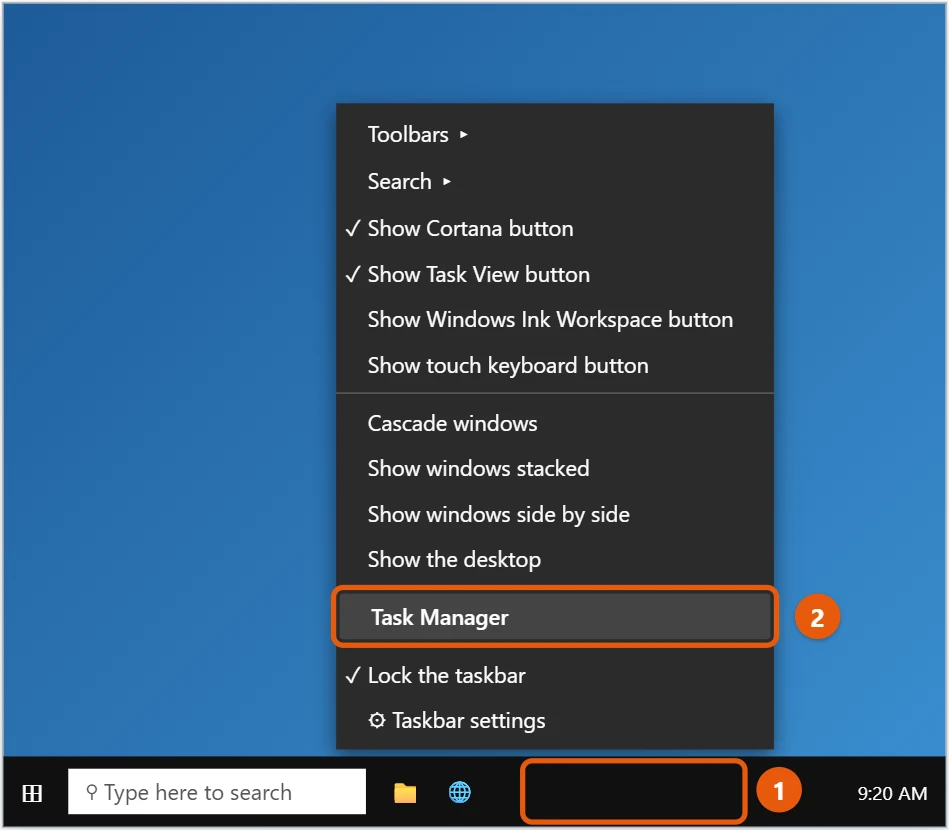
- Taskbar: right-click an empty spot on the taskbar and select Task Manager.
- Start button: right-click Start (or press Windows logo key + X) and select Task Manager.
- Security screen: press Ctrl + Alt + Delete and select Task Manager. This works even when the screen seems frozen. If the taskbar is what froze, you can then restart Windows Explorer.
- Search: type
task managerin the search box on the taskbar and select it. - Run: press Windows logo key + R, type
taskmgr, and press Enter. - Command Prompt or PowerShell: type
taskmgrand press Enter.
See more details
Task Manager may open as a small list of apps. Select More details at the bottom to see the full view with tabs such as Processes, Performance, and Startup.
What each tab shows
- Processes: open apps and background processes, with how much processor, memory, disk, and network each uses.
- Performance: live graphs for the processor, memory, drives, network, and graphics card.
- App history: how much processor time and data each Store app has used.
- Startup: apps that open when you sign in, and how much each slows startup.
- Users: who is signed in and what each person is running.
- Details and Services: every running program file and Windows service, for more advanced troubleshooting.
Close an app that isn’t responding
- Open Task Manager.
- On the Processes tab, select the app.
- Select End task.
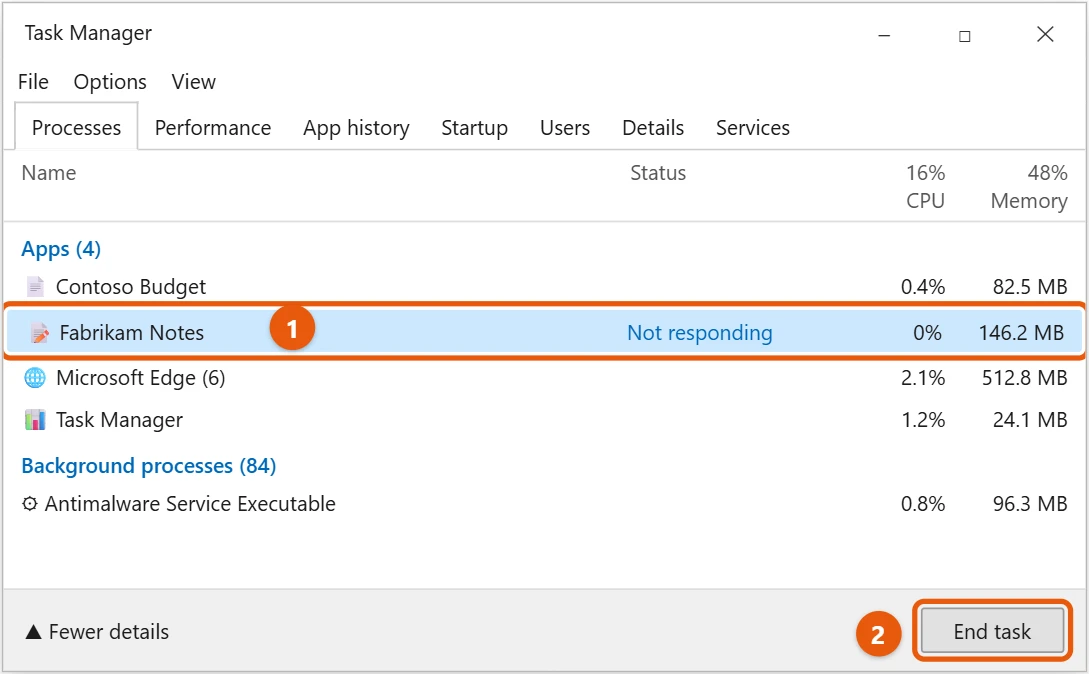
Unsaved work in that app is lost, so only end apps you can’t close normally.
Pin Task Manager to the taskbar
With Task Manager open, right-click its taskbar icon and select Pin to taskbar.
If Task Manager doesn’t work properly
- The numbers stop changing. Task Manager’s updates may be paused. Select View > Update speed and choose Normal.
- It opens off the screen. Select its icon on the taskbar, press Alt + Space, select Move, and use the arrow keys to bring it back.
- It opens and closes right away, or won’t open at all. Run sfc /scannow in an administrator Command Prompt to repair Windows files, then run a full scan in Windows Security.
Frequently asked questions
Task Manager says it has been disabled by your administrator. What now?
On a work or school PC, your organization turned it off, so contact your IT team.
How do I stop apps from opening at startup?
Use the Startup tab in Task Manager. See how to disable startup programs in Windows 10.
How do I keep Task Manager on top of other windows?
In Task Manager, select Options > Always on top. It stays visible even when you switch to a game or another full-screen app.
Can I open Task Manager on a specific tab?
Not directly, but Task Manager remembers the last tab you used. Leave it on the tab you want, and it opens there next time.
Is it safe to end processes I don’t recognize?
Not always. Some belong to Windows, and ending them can freeze or restart your PC. Search for a process name before you end it, and stick to ending apps you opened yourself.
To group your open apps into separate workspaces, see how to use virtual desktops in Windows 10.
If copy and paste stops working, restarting Windows Explorer in Task Manager often helps. See how to copy and paste in Windows 10.
If an app stops responding, see how to force close an app in Windows 10.
Restarting Windows Explorer from Task Manager can also fix a stuck search box. See how to fix Windows Search not working in Windows 10.
To give one program more of your processor’s time, see how to set a program to high priority in Windows 10.
To read the graphs on the Performance tab, see how to check PC performance in Windows 10.
Microsoft’s guide is System configuration tools in Windows. More help is on our Windows Help & Guides page.
Related: how to check uptime in Windows 10.

Matt Jacobs has been working as an IT consultant for small businesses since receiving his Master’s degree in 2003. While he still does some consulting work, his primary focus now is on creating technology support content for SupportYourTech.com.
His work can be found on many websites and focuses on topics such as Microsoft Office, Apple devices, Android devices, Photoshop, and more.